
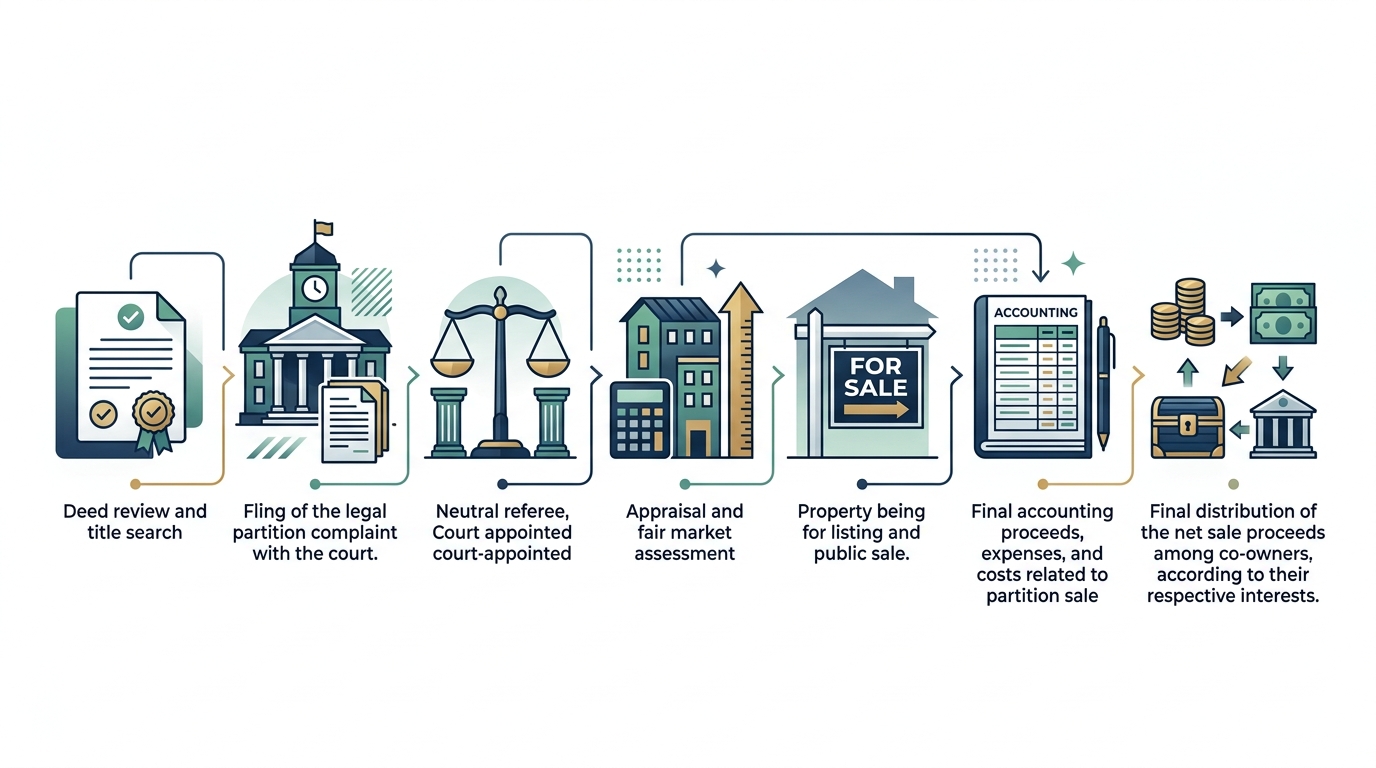
The California Partition Process: From Filing the Case to Sale or Division of the Property
A California real-property partition action is a court process used to separate co-owners’ interests in property when they cannot reach a voluntary agreement. The result may be a physical division in the uncommon situation where that is practical, or more often a sale followed by an accounting and distribution of the net proceeds. The path is highly fact-specific: timing, procedure, and outcomes can vary with the court, title history, property type, disputes between the parties, liens, and applicable statutes.
For property owners and referring attorneys in the Bay Area, it can help to view a partition case as a sequence of connected steps rather than a single request to sell real estate. Harrington Law P.C. brings a fiduciary-focused perspective to these matters, including service as a court-appointed partition referee when the court determines that appointment is appropriate.
Step 1: Evaluate Ownership, Title, and the Property
The work often begins before a complaint is filed. The parties and their counsel need to identify who holds record title, how title is held, and whether every person or entity with a relevant interest has been identified. A preliminary title report, recorded deeds, loan documents, agreements between co-owners, and estate or trust documents may all matter.
Ownership questions are not always as simple as the deed suggests. Property may be held by a revocable trust, an estate in probate administration, a conservatorship, a business entity, or individuals who disagree about their respective percentages. In matters involving trust administration, estate planning, conservatorships, or probate law, the person authorized to participate in litigation may be a trustee, personal representative, conservator, or other fiduciary rather than a beneficiary or family member.
This early review should also identify mortgages, tax liens, judgment liens, leases, easements, and other recorded or unrecorded issues that may affect a sale, division, or ultimate distribution. A careful title analysis helps define the proper parties and avoids surprises later in the case.
Step 2: File and Serve the Partition Action
A partition action generally begins with a complaint filed in the appropriate California Superior Court. The pleading ordinarily identifies the property, the claimed ownership interests, the parties whose interests may be affected, and the relief requested. Depending on the circumstances, the action may also include related claims concerning possession, contribution, waste, rents, improvements, or accounting.
After filing, the plaintiff must arrange for service of the summons and complaint on the defendants. Service and notice requirements are procedural necessities, not technicalities to overlook. Defendants have an opportunity to respond, raise defenses, assert their own claims, and dispute the requested relief or ownership percentages.
In a Bay Area property dispute, the pace may be influenced by the county’s calendar, the number of parties, whether anyone is difficult to locate, and the complexity of the title or financial record. Early, organized communication among counsel, title professionals, and fiduciaries can make the process more manageable.
Step 3: Determine Whether Partition Is Available
The court must determine the parties’ rights before deciding how the property should be divided or sold. California law generally recognizes a co-owner’s right to partition, but that right can be affected by the form of ownership, agreements between the parties, defenses, and equitable considerations.
At this stage, disputes may involve whether a party actually has a present ownership interest, whether a claimed waiver or agreement limits partition, and whether there are competing trust litigation or probate issues that must be resolved. The court may also need to decide each owner’s fractional interest. A case can be straightforward when the deed and ownership percentages are undisputed, but it can become more involved when family transfers, fiduciary decisions, or alleged contributions are contested.
Step 4: Obtain an Interlocutory Judgment or Order
If the court determines that partition should proceed, it may enter an interlocutory judgment or order addressing the parties’ rights and directing the method of partition. The order may call for division in kind, sale of the property, or another authorized approach consistent with the circumstances.
For a single residence, condominium, or other property that cannot realistically be divided without impairing value, a sale is often the practical route. Land with usable, legally divisible portions may call for a different analysis. The court’s order provides the roadmap for the next phase; its scope and wording matter because they guide the work of any appointed referee.
Step 5: Appoint and Instruct the Partition Referee
When the court orders a division or sale, it may appoint a partition referee to carry out the assigned responsibilities. The referee is a neutral officer of the court, not an advocate for either co-owner. The appointment order may define the referee’s authority, reporting obligations, compensation process, and any need for further court approval.
Harrington Law P.C. has experience providing fiduciary services in court-appointed roles, including as a partition referee. From a practical standpoint, the referee’s work may involve reviewing the court’s instructions, coordinating with the parties and counsel, engaging appropriate professionals, protecting the property while the matter is pending, and maintaining a clear record of material decisions and expenditures.
The details of an appointment vary. Parties should not assume that every referee has the same authority or that every proposed action may be taken without notice, consent, or a further court order. The operative orders and the applicable statutes control.
Step 6: Value and Prepare the Property
Before a property can be marketed or physically divided, the referee and parties may need reliable information about value and condition. This can include appraisals, broker opinions, inspections, surveys, repair estimates, occupancy information, and review of title or lien payoff demands.
Preparation may require practical decisions about access, securing vacant property, ordinary maintenance, insurance, cleaning, repairs, or the handling of personal property. Those decisions should be made carefully because they can affect marketability, cost, and the eventual accounting between co-owners. For complex records, a forensic accounting approach may help organize expenditures, rental income, loan payments, and claimed improvements.
Step 7: Market the Property or Complete a Physical Division
If the court orders a sale, the referee typically follows the authority set out in the court’s order to market the property and evaluate offers. A knowledgeable real estate professional may assist with pricing, marketing strategy, showings, disclosures, and the mechanics of a proposed transaction. The goal is not to promise a particular price or timeline, but to conduct the authorized process in a documented and commercially sensible manner.
If the property is suitable for division in kind, the process may instead involve surveys, proposed legal descriptions, local land-use requirements, access considerations, and allocation of any equalizing payments. Physical division is not merely drawing a line on a map; the resulting parcels must be workable and legally supportable.
Step 8: Seek Court Review or Confirmation When Required
Some actions taken in a partition case require court review, confirmation, or additional direction. The need for approval can depend on the court’s prior orders, the method of sale, objections from parties, and the applicable procedural rules.
A referee may submit a report describing the work completed, the proposed sale or division, costs incurred, and issues requiring the court’s attention. Parties may have an opportunity to review the report and raise objections. Court oversight can add time, but it also creates a structured process for resolving disputes and confirming that the next step is authorized.
Step 9: Pay Liens, Costs, and Other Authorized Expenses
After a sale closes, the gross proceeds are not automatically ready for distribution. First, valid liens and closing obligations generally must be addressed. These may include mortgages, property taxes, judgment liens, escrow charges, transfer-related costs, broker compensation, insurance or maintenance expenses, and authorized referee or professional fees.
How partition costs are allocated can depend on the court’s orders, statutes, and the particular facts. A party whose conduct caused unnecessary expense may raise different issues than a case in which all parties benefited from the process. Clear records are essential for attorneys, fiduciaries, and co-owners alike.
Step 10: Complete the Accounting and Distribute Net Proceeds
The final financial step is usually an accounting between co-owners followed by distribution of net proceeds. The accounting can address more than the deed percentages. Depending on the case, the court may consider contributions toward purchase costs, mortgage payments, taxes, insurance, necessary repairs, improvements, rental income, use and occupancy, and other equitable adjustments.
Not every dollar spent on a property produces the same credit, and not every claimed expense will be allowed in the same way. This is where detailed documents, bank records, invoices, loan histories, and a carefully prepared fiduciary or forensic accounting can be especially valuable.
Once liens, authorized costs, and approved adjustments are resolved, the remaining proceeds can be distributed according to the court’s orders. In a matter involving an estate or trust, that distribution may then continue through the applicable probate or trust administration process.
Why Experienced Coordination Matters
Partition cases often sit at the intersection of real property, family relationships, trusts, estates, and fiduciary duties. Harrington Law P.C. serves clients throughout San Francisco, the Bay Area, and the North Bay with an emphasis on clear communication and thoughtful administration of complex matters. For referring attorneys, early coordination around title, authority, accounting, and the proposed scope of a referee’s role can help frame the case efficiently.
This overview is educational, not legal advice for any particular dispute. A California partition action may move more quickly or slowly depending on the court, the property, the parties’ cooperation, disputed facts, related proceedings, and changing procedural requirements. A tailored review is the best way to understand the options and responsibilities in a specific matter.
FAQ
Can one co-owner force the sale of California property?
A co-owner may have a right to seek partition, but the court must first determine the parties’ interests and the appropriate remedy. Whether the property is sold, physically divided, or handled another way depends on the facts, court orders, and applicable law.
How long does a California partition action take?
There is no universal timeline. Uncontested cases may move differently from cases involving title disputes, uncooperative parties, probate or trust litigation, complicated liens, occupancy questions, or objections to a proposed sale or accounting.
What does a partition referee do?
A partition referee is a neutral court appointee who performs the duties authorized by the court. Depending on the order, those duties may include coordinating a sale or division, working with professionals, preserving the property, reporting to the court, and accounting for authorized funds and expenses.
Are mortgage payments and property improvements considered in the final division?
They may be. The court may consider properly supported claims for contributions, expenses, rents, repairs, improvements, and use of the property as part of the accounting. The treatment of any particular item depends on the evidence, legal standards, and court rulings.
What if the property is held in a trust or estate?
The authorized trustee, personal representative, or other fiduciary may need to participate, and trust or probate issues may affect the case. Harrington Law P.C. can help parties and referring counsel assess how a partition matter intersects with trust administration, fiduciary responsibilities, and related estate proceedings.